DR. WATSON'S MEMOIRS: THE CASE OF THE DEPTFORD SHADOWS


🎙️ SHOW NOTES
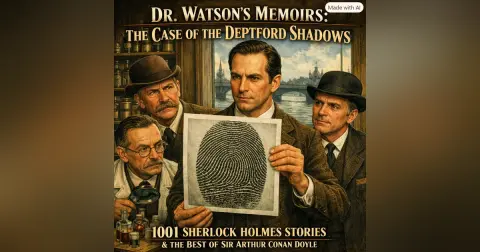
Dr. Watson's Memoirs: The Case of the Deptford Shadows
Series: 1001 Sherlock Holmes Stories & The Best of Sir Arthur Conan Doyle
In this newly unearthed folio from Dr. Watson's dusty box, Holmes investigates a brutal double assault in Deptford — a case that marks the dawn of forensic science. When a faint thumbprint is discovered on a cash box, Holmes visits Scotland Yard's fledgling Fingerprint Bureau to learn the revolutionary technique of dusting for prints.
Armed with this new method, Holmes uncovers two distinct fingerprints — one on the cash box, another on a glass left behind in the kitchen — leading him to a pair of brothers whose greed and desperation have turned deadly. The case culminates in a tense confrontation at the docks, where Holmes's physical prowess and deductive brilliance bring the culprits to justice.
This story blends historical fact with Holmesian fiction, inspired by the real‑life Stratton Brothers case of 1905, the first British murder conviction based on fingerprint evidence.
🕵️ HOST NOTES
Before we close today's episode, a bit of real history behind the science featured in this story:
In 1901, Scotland Yard officially established its Fingerprint Bureau, the first of its kind in Britain. It was led by Detective Inspector Charles Stockley Collins, under the direction of Sir Edward Henry, whose classification system became the foundation of modern fingerprint identification.
Just four years later, fingerprints were used for the first time in Britain to secure a murder conviction. The case involved two brothers — Alfred and Albert Stratton — and became known as the Deptford Murders or the Mask Murders. A single thumbprint left on a cash box was enough to place one of the brothers at the scene, and the case became a landmark moment in forensic history.
Sherlock Holmes, of course, had been using fingerprint logic in fiction long before Scotland Yard adopted it in reality — always a step ahead of his time.
And speaking of Scotland Yard, Inspector G. Lestrade appears in the Holmes canon thirteen times, making him one of the most frequently recurring characters in the entire series. Though often skeptical, Lestrade consistently relied on Holmes when cases grew too complex for conventional police methods. Their relationship — part rivalry, part respect — remains one of the great threads running through the original stories.
This week, I'll be featuring two classic Holmes adventures involving Inspector Lestrade:
🔹 Wednesday at 4 PM ET:
"The Adventure of the Norwood Builder" Lestrade believes he's solved a murder — until Holmes proves otherwise.
🔹 Friday at 4 PM ET:
"The Adventure of the Six Napoleons" Lestrade and Holmes join forces to unravel a mystery involving smashed statues, a hidden pearl, and one of the most satisfying endings in the canon.
Join me for both — and next week, we'll open another folio from Dr. Watson's great dusty box.


