

THE BATTLE OF MIDWAY-THE TURNING POINT OF WWII & THE BATTLE THAT CHANGED NAVAL WARFARE FOREVER
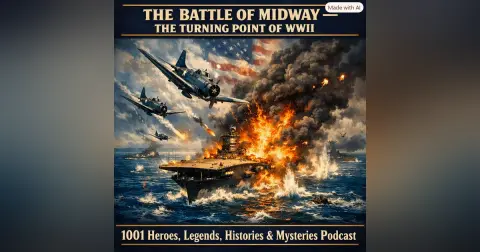
1001 HEROES, LEGENDS, HISTORIES & MYSTERIES
The Battle of Midway — The Turning Point of WWII & The Battle That Changed Naval Warfare Forever
Part Two- Interview with authors of "Never Call Me A Hero" The story of dive bomber pilot Dusty Kleiss, arrives Friday 4pm ET
EPISODE DESCRIPTION
Six months after Pearl Harbor, the United States Navy had every reason to believe it was losing the Pacific War. Japan was unstoppable, expanding across the ocean at will. Then, in four days in June 1942, everything changed. The Battle of Midway was not just an American victory — it was one of the most decisive and improbable reversals in military history. We tell the full story: what led to it, the extraordinary intelligence operation that made it possible, the courage of the men who flew into overwhelming odds, and why Midway permanently changed the way naval warfare is fought. And we hear it in the words of those who were actually there — through rare and remarkable DOD interviews with the veterans who lived every moment of it.
ABOUT THE BATTLE
The Battle of Midway was fought June 3 through 6, 1942, in the Central Pacific Ocean near Midway Atoll. The U.S. Pacific Fleet was commanded by Admiral Chester W. Nimitz. The Japanese Combined Fleet was commanded by Admiral Isoroku Yamamoto. The result was a decisive American victory and the acknowledged turning point of the Pacific War. Japan lost four fleet carriers, one cruiser, 292 aircraft, and approximately 3,000 men. The United States lost the carrier USS Yorktown, one destroyer, 145 aircraft, and 307 men.
WHAT LED TO IT
After Pearl Harbor, Japan swept across the Pacific with terrifying speed — taking the Philippines, Guam, Wake Island, and the Dutch East Indies within months. Admiral Yamamoto, architect of the Pearl Harbor attack, knew that America's industrial power meant Japan's window of superiority was narrow. His plan: draw out and destroy what remained of the U.S. Pacific Fleet with a massive surprise attack on Midway Atoll, a small but strategically vital island sitting roughly halfway between Japan and the U.S. mainland. Four of Japan's most powerful fleet carriers — the Akagi, Kaga, Soryu, and Hiryu — would lead the assault. Yamamoto was confident. He had every reason to be. What he didn't know was that the Americans were reading his mail.
THE INTELLIGENCE WIN
In a windowless basement beneath a Pearl Harbor administrative building, a small team of Navy cryptanalysts known as Station HYPO, led by Lieutenant Commander Joseph Rochefort, had been painstakingly cracking Japan's operational code — JN-25b. By April 1942 they had broken enough of it to determine that Japan was planning a major strike on a location referred to only as "AF." Rochefort was convinced AF was Midway. To prove it, he arranged for Midway's garrison to broadcast a fake radio message reporting their fresh water system had failed. Days later, a Japanese intercept reported that "AF" was short on fresh water. Midway confirmed.
Admiral Nimitz now knew the where, the when, and the order of battle. He positioned his three carriers — Enterprise, Hornet, and the battle-damaged Yorktown, repaired in 72 hours instead of the estimated 90 days — north of Midway in ambush. Japan sailed into a trap it never saw coming.
THE BATTLE
On the morning of June 4, Japanese aircraft struck Midway. But the planes Yamamoto expected to destroy were already airborne. Wave after wave of American torpedo bombers attacked the Japanese carriers and were slaughtered — the slow TBD Devastators cut down by Zeros with devastating losses. But those attacks kept the Japanese fighters low and the carrier decks in chaos, loaded with fuel, bombs, and rearming aircraft. Then the dive bombers arrived from above. In just five minutes, three of Japan's four carriers — Akagi, Kaga, and Soryu — were mortally hit and burning. The Hiryu struck back and badly damaged the Yorktown, before American dive bombers found and sank her as well. By June 6 it was over. Japan had lost four irreplaceable fleet carriers and hundreds of its most experienced aviators — losses it would never recover from.
HOW IT CHANGED NAVAL WARFARE FOREVER
Midway confirmed what was first suggested at the Battle of the Coral Sea just one month earlier — the era of the battleship was over. Midway was decided entirely by aircraft operating from carriers. The great surface gun fleets never came within firing range of each other. Aircraft carrier task forces would dominate naval doctrine from that day forward, a transformation that defines naval strategy to this very day.
THE VETERANS WHO WERE THERE
In this episode you will hear directly from the men who lived it — through rare DOD interviews with numerous veterans of the Battle of Midway. Pilots who flew those torpedo runs knowing the odds. Sailors who watched carriers burn on the horizon. Survivors who carried the memory of lost shipmates for the rest of their lives. Their words bring a depth to this story that no historian alone can provide. This is history told by the people who made it.
WHERE TO LEARN MORE
National Museum of the Pacific War — nationalmuseumofthepacificwar.org
Naval History and Heritage Command — history.navy.mil
Film: Midway (2019); The Battle of Midway (1942, dir. John Ford — filmed on location during the actual battle, Academy Award winner)
COMING THIS SUNDAY
Part 2 of Remembering Steve McQueen — His Top Ten Movies and Some Memories arrives this Sunday at noon ET, right here on 1001 Heroes, Legends, Histories & Mysteries. Last week we counted down films ten through six. This Sunday we reach the top five — the roles that defined the King of Cool — along with personal memories of what it meant to watch Steve McQueen on screen. Sunday. Noon Eastern. Don't miss it.