THE REVOLT OF MOTHER by MARY E. WILKINS FREEMAN
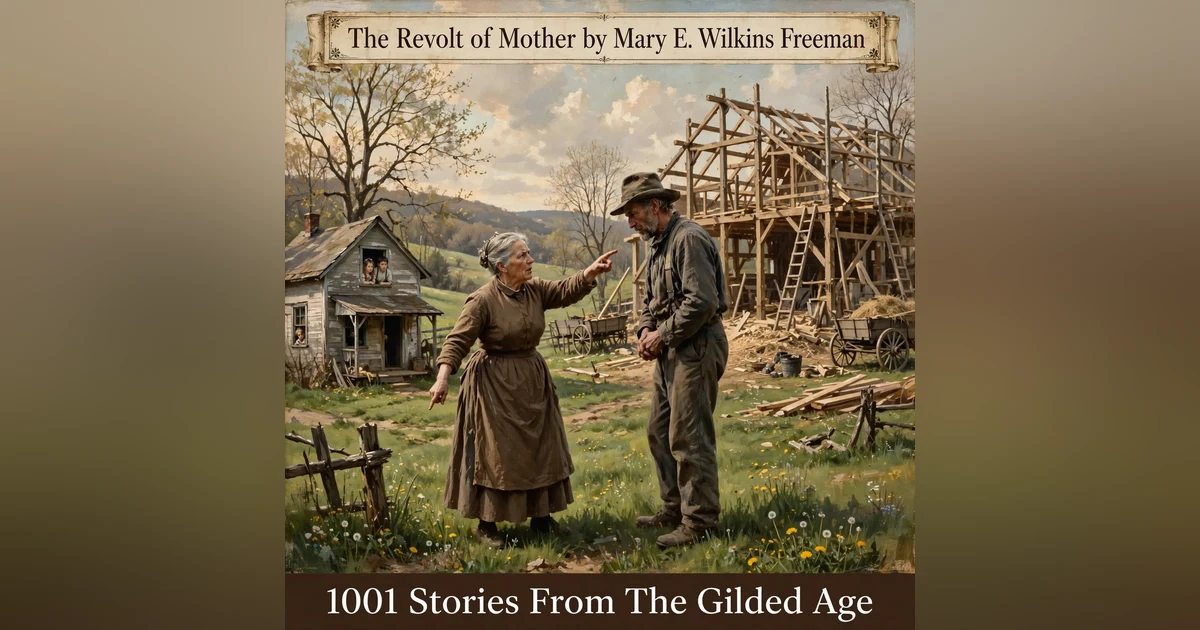


⭐ 1001 STORIES FROM THE GILDED AGE
SHOW NOTES — THE REVOLT OF “MOTHER”
By Mary E. Wilkins Freeman (1890)
Mary E. Wilkins Freeman’s The Revolt of “Mother” is one of the most quietly powerful acts of rebellion in American literature — a story that takes place not in a courtroom or a battlefield, but in a kitchen, a barn, and the emotional landscape of a long marriage.
The story follows Sarah Penn, a hardworking New England farm wife who has spent forty years raising children, keeping house, and supporting her husband Adoniram, a man of few words and rigid habits. When Sarah discovers that Adoniram has broken a decades‑old promise to build her a new home — choosing instead to construct a brand‑new barn — she reaches a breaking point.
But Freeman’s revolt is not loud. It is not violent. It is not theatrical.
It is quiet, practical, and brilliant.
Sarah Penn simply decides to take the barn — the structure her husband valued more than the comfort of his family — and turn it into the home she was promised. In doing so, she forces Adoniram, her children, and her entire community to see her clearly for the first time.
This is a story about dignity, promises, pride, and the moment when a woman who has been underestimated for decades finally says, in her own way, enough.
⭐ ABOUT THE AUTHOR — MARY E. WILKINS FREEMAN
Mary E. Wilkins Freeman (1852–1930) was one of the most important American short‑story writers of the late 19th century. Born in rural Massachusetts, she grew up surrounded by the quiet rhythms of New England life — the farms, the small towns, the strict social expectations, and the emotional restraint that shaped the region.
Freeman wrote about ordinary people with extraordinary insight. Her stories often center on:
-
Women whose strength is overlooked
-
Marriages strained by silence
-
The moral weight of promises
-
The quiet heroism of domestic life
-
New England stubbornness, pride, and humor
She published in Harper’s, The Atlantic, Century Magazine, and became one of the defining voices of American realism. Her work remains essential reading for anyone interested in the emotional and social fabric of the Gilded Age.
⭐ WHAT INSPIRED THE REVOLT OF “MOTHER”?
Freeman never left a single definitive explanation, but scholars agree on several strong influences:
1. Real New England Marriages
Freeman grew up watching marriages where men made decisions without consulting their wives — especially about property, money, and homebuilding. Sarah Penn is drawn directly from these women.
2. A Real Barn‑Building Incident
Freeman once mentioned hearing a local story about a farmer who built a barn instead of the new house he had promised his wife. The woman didn’t revolt — but Freeman imagined what would happen if she did.
3. Freeman’s Own Frustrations
Freeman spent much of her early life caring for sick parents, sacrificing her own independence. She understood the emotional cost of duty and the quiet resentment that can build over decades.
4. The Rise of Women’s Voices in Print
By the 1890s, women writers were beginning to challenge traditional roles. Freeman used fiction to show that domestic life was not trivial — it was the center of American life, and women were its backbone.
⭐ FEATURED NETWORK RECOMMENDATION
1001 TRUE CRIME FROM ANOTHER TIME
If you enjoy deep‑dive storytelling, atmospheric history, and mysteries that shaped entire eras, you’ll love 1001 True Crime From Another Time — one of the most compelling shows in the 1001 Stories Network.
This podcast brings you:
-
Vintage crimes from the 1800s through mid‑20th century
-
Forgotten investigations and unsolved cases
-
Newspaper reporting from the era
-
Detectives with unforgettable names
-
Strange details you won’t hear anywhere else
-
Cinematic, immersive storytelling in the classic 1001 style
From the Black Dahlia to frontier murders, Gilded Age scandals, Jazz Age disappearances, and early FBI cases — these are the crimes that shaped America long before modern forensics and media.
Follow 1001 True Crime From Another Time today and step into a world where every case is a time capsule.


